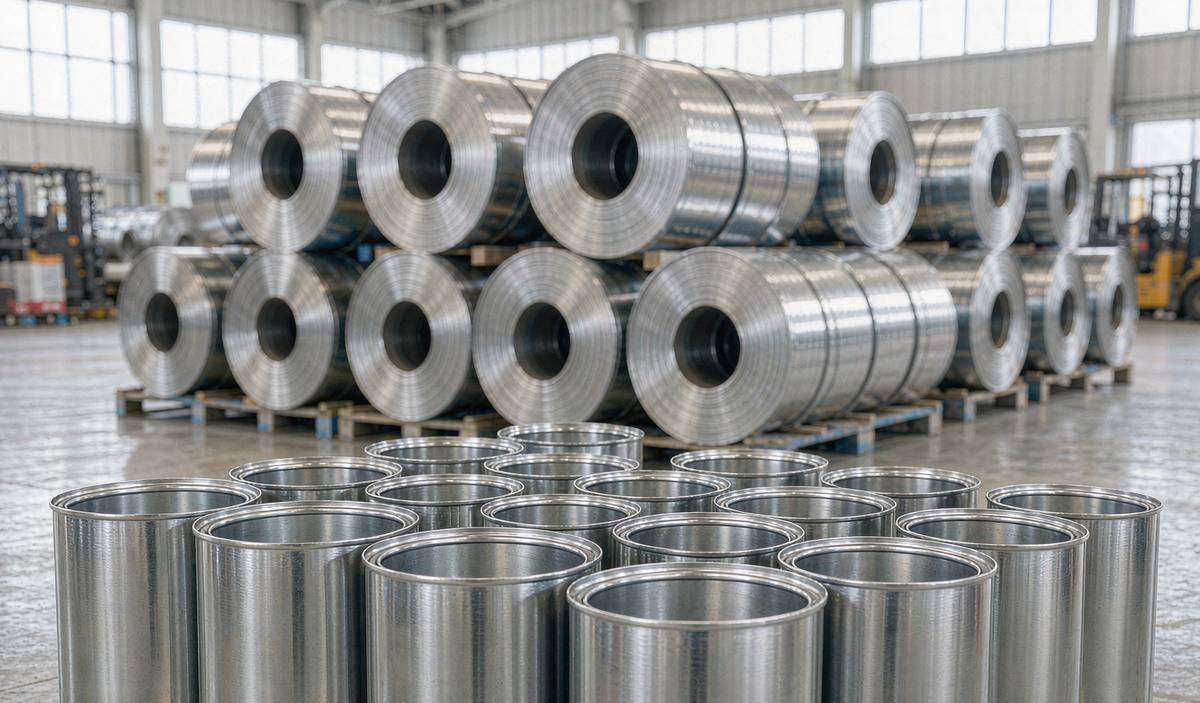
On 9 November 2026, the European Commission formally opened a new anti-dumping investigation into tin-coated flat-rolled iron and steel products from China, following a complaint filed by the European Steel Association (Eurofer). For most buyers of custom tin cans, that headline sits somewhere between background noise and urgent. The truth is closer to urgent: this is now the fourth separate trade-remedy front affecting the tinplate that goes into your packaging, and it arrives on top of a brand-new EU quota regime that cut China's duty-free tinplate allocation by roughly two-thirds.
This article is a sourcing map, not a market commentary. It lays out which measures exist, which dates matter, and what a tin can buyer should change in RFQs, contracts and delivery calendars before the next wave of provisional duties lands.
The New EU Case: What Was Actually Opened
The case, initiated on 9 November 2026, covers tin-coated flat-rolled steel — the substrate every three-piece food tin, cookie tin and coffee caddy starts from. Eurofer alleges that Chinese producers benefit from distorted raw material input prices, which it puts at 60–70% of production cost. The investigation can run up to 14 months, with provisional duties possible within 7–8 months of initiation — realistically, mid-2027.
Two things make this case different from routine trade friction. First, it stacks: Chinese tinplate already carries definitive anti-dumping duties of 13–62% imposed in May 2025, so a new measure would land on top of the old one. Second, it is part of a pattern. According to BigMint data, global anti-dumping actions on steel products are on track to cross 30 separate cases in 2026 — a structural, multi-jurisdiction escalation rather than isolated disputes. Thailand opened a sunset review of its own tinplate duties on 13 November 2026, covering 15 tariff lines under heading 7210.12 from China, Taiwan, the EU and Korea, with existing duties remaining in force during the review. Pakistan extended its 40.47% duty on Chinese galvanized sheet to Galvalume coils after exporters shifted coating composition to skirt the original scope.
That last point is the one buyers should internalise: the product scope of these cases is migrating from basic hot-rolled and cold-rolled coil into tinplate and coated specialty products. A substrate that was outside the net last quarter can be inside it this quarter.
The Quota Regime Nobody Mentions: Regulation (EU) 2026/1457
While the new probe dominates headlines, the harder constraint since 1 July 2026 has been the EU's replacement of its steel safeguard with a quota-plus-duty system under Implementing Regulation (EU) 2026/1457. Tinplate sits in category 6 ("Tin Mill products"), spanning ten CN codes including 7209 18 99, 7210 11 00 and 7210 12 20. The headline numbers for the regime running 1 July to 31 December 2026:
| Origin | Duty-free quota (tonnes/year) | vs. old safeguard |
|---|---|---|
| China | 153,409 (38,352 per quarter, first-come-first-served) | −65.6% |
| United Kingdom | 62,472 | −61.5% |
| Serbia | 60,844 | −31.9% |
| Türkiye | 57,114 (new) | no prior own quota |
| Korea | 55,522 | −14.1% |
| India | 47,009 (new) | no prior own quota |
| Taiwan | none (draws on "other countries" pool) | lost own 53,762 t quota |
Three details in the annexes matter more than the totals. China's quota is MFN-only and China is excluded from the "other countries" pool — once a quarterly 38,352-tonne window is exhausted, Chinese tinplate faces the 50% above-quota duty stacked on top of the existing anti-dumping duty. India, Korea, Türkiye and the UK get an FTA back-up pool of 45,019 tonnes, but only after exhausting their own quota. And Taiwan lost its dedicated allocation entirely, now competing with every non-quota origin for 6,447 tonnes per quarter.
For a food brand importing finished tins into the EU — a category we cover in depth in our food tin industry guide, this is not a direct customs charge on cans. But it is a live transmission mechanism: European converters pay more for substrate as quarterly windows tighten, and quoted tin can prices from EU-based filling partners will reflect it.
The Full Trade-Remedy Map for Tinplate, November 2026
| Jurisdiction | Measure on tinplate / tin mill | Status & key dates |
|---|---|---|
| EU | AD 13–62% (2025) + new anti-dumping investigation | New case initiated 9 Nov 2026; provisional duties possible mid-2027; quota regime 2026/1457 since 1 Jul 2026 |
| US | Section 232 tariffs 50% (steel & derivatives) + AD/CVD investigation | China preliminary 196.78% (published 10 Nov 2026); Taiwan prelim 18.07%; Türkiye 3.89% / 42.06% (Tatrix, adverse facts); Tatrix entries retroactive to ~12 Aug 2026 under critical circumstances |
| UK | Definitive anti-dumping 27.85–49.98% | In force since March 2026 |
| EAEU | Definitive safeguard 25.2% (year one, −1%/yr) | Adopted Aug 2026; Russia was China's largest tinplate destination |
| Thailand | Sunset review of existing AD duties | Opened 13 Nov 2026; duties remain in force during review |
| Saudi Arabia | Anti-dumping on aluminum beverage can ends, 5 years | Adjacent signal: even can components are now remedy targets |
The US numbers deserve one clarification for buyers of finished custom tins: the American anti-dumping case (A-570-228 and parallel cases) covers flat-rolled tin mill products, not formed cans — our earlier breakdown of the 196.78% scope and its retroactive clock covers that in detail. The transmission to your tin can pricing runs through converters' substrate costs and through Section 232's coverage of derivative articles, not through a direct duty on a decorated can.
What the Export Data Actually Shows
Chinese customs and Mysteel data confirm the wall is biting. Tinplate exports for January–September 2026 totalled 1.1265 million tonnes, down 23.7% year on year — the second consecutive year of decline — with export value down 23.9% to $1.034 billion. Average export prices have slid to $915.8 per tonne from $1,464.8 in the same period of 2022: the "compete on price" model has stopped converting into volume precisely because tariffs neutralise the discount. Shipments to the US collapsed 43.9% under the 50% Section 232 tariff, while volume rotated east and south — the UAE grew 15.2% and Spain jumped 32.9% to become the fifth-largest destination.
Domestically, production has not followed demand down: tinplate output for January–October ran 4.4732 million tonnes (+3.6%), with roughly 1 million tonnes of new tinplating capacity from four lines coming online in H2 2026. More capacity competing for fewer export lanes is precisely the environment in which trade-remedy petitions multiply.
Five Moves for Tin Can Buyers Before Mid-2027
- Check scope at HS-code level, not headline level. The measures live in tariff lines (7210.11, 7210.12, 7225.99 for substrate; separate chapters for finished containers). Ask each supplier to confirm in writing which lines their input material and your finished cans fall under, per destination market.
- Demand origin and coating documentation that survives a scope expansion. The practical compliance question is no longer "is my HS code covered?" but "can my supplier produce mill certificates, coating specs and origin evidence that survive a widening product scope?" Make it a standing RFQ attachment, not a one-off ask.
- Time orders against quota quarters and the investigation clock. Quarterly EU windows and a possible provisional-duty decision around mid-2027 create real price cliffs. Lock pricing on longer-term agreements now rather than re-quoting into a provisional-duty environment.
- Diversify origin — but cost it honestly. Second-origin sourcing is sensible risk management, yet every candidate origin carries its own duty exposure (Türkiye now has EU quotas of its own; Taiwan lost its EU quota outright). Compare landed cost, not FOB.
- Fix the calendar before CNY. Chinese New Year 2027 falls on 6 February with the official holiday through 13 February. Custom tin can production runs 21–28 days for repeat orders and 35–45 days with new tooling, and tins carry some of the longest lead times of any packaging category (up to ~40 days). Orders confirmed with deposit after 20 December risk slipping past the January sailing window; add 5–7 days for Q4 peak-season congestion.
Indicative Custom Tin Can Pricing, November 2026
| Programme | MOQ | Unit price (FOB China) | Lead time |
|---|---|---|---|
| Stock mould + custom CMYK print | 3,000–5,000 / design | $0.28–0.65 | 21–28 days |
| Full custom size + new tooling | 10,000+ | $0.20–0.85 + tooling | 35–45 days |
| Pilot run, digital print on stock mould | 500–1,000 | $0.45–1.10 | 15–20 days |
| Q4 / pre-CNY surcharge window | — | +5–7 days lead | confirm by 20 Dec |
Why None of This Changes the Material Choice
It would be easy to read a wall of tariffs as a signal to switch substrates. The data says otherwise. Aluminum is not an escape route — Washington's Section 232 regime hits aluminum at the same 50% rate, and Saudi Arabia's new five-year anti-dumping order targets aluminum can ends specifically. Fiber-based packaging imports a different compliance burden entirely, from EUDR geolocation traceability on paper components to the absence of magnetic recovery at end of life. Tinplate remains the substrate that recovers magnetically in every major sorting system, cycles without downgrading, carries no recycled-content mandate under PPWR, and sits in the lowest band of 2027 EPR eco-modulation fee schedules for steel at €0.33/kg versus €1.08–2.21/kg for plastic films.
The trade-remedy wall is an origin-and-documentation problem, not a material problem. For a custom printed food tin programme, the winning position in 2027 is a supplier who can evidence substrate origin per shipment, hold tooling and artwork in a form that can move across production sites, and quote with tariff scenarios priced in — not a buyer who abandoned the format with the best recycling economics on the shelf. If you are planning Q1 2027 programmes, our custom tin can service covers tooling, artwork and compliance documentation as a single package.
The Eight-Point RFQ Checklist for a Tariffed Market
- HS codes for finished cans and substrate, per destination market, confirmed in writing
- Mill certificate: grade, temper, gauge, tin coating mass per side, origin mill
- Coating system declaration (lacquer type, BPA-NI status, PFAS position)
- Quota/tariff scenario pricing: quote at current duty, at +provisional AD, at above-quota 50%
- Second-origin contingency: which alternate production site, same tooling, same spec
- Ex-works vs. placed-on-market dates written into the PI (duty and labelling clocks both run on placement, not order date)
- Lead-time commitment with Q4/CNY calendar: deposit date, production window, vessel booking
- Compliance file retention: DoC and test reports held 5–10 years per PPWR retention rules
The Bottom Line
Four separate remedy fronts, a quota regime that cut China's duty-free tinplate access by two-thirds, and an export base already down 23.7% — 2027 sourcing for tin cans will be decided by documentation discipline and calendar discipline more than by unit price. The buyers who lock specifications, evidence and deposit dates before 20 December will be quoting from a position of strength in June 2027, when the EU's provisional-duty decision window opens. Everyone else will be re-quoting into it.
Need Help Choosing the Right Tin?
Tell us what you plan to pack and share an article or model you found useful. We can help confirm size, closure and sample options.