What the UK CBAM Actually Covers — and Where Tinplate Cans Sit
For three years the EU Carbon Border Adjustment Mechanism (CBAM) has been the compliance story every tinplate exporter tracked. From 1 January 2027 the United Kingdom opens a second, separate carbon border tax. If you ship tinplate cans into Great Britain, you now have two carbon-accounting regimes to satisfy — and they are not the same rulebook.
The UK CBAM was written into law through the Finance Act 2026, which received Royal Assent on 18 March 2026. It taxes the embedded carbon in five imported goods: aluminium, cement, fertilisers, hydrogen, and iron and steel. Notice what is missing — the UK list excludes electricity, which the EU scheme still covers. That single omission matters less to packaging buyers than the inclusion of iron and steel does.
Tinplate is, at its core, cold-reduced low-carbon steel sheet carrying a thin tin coating (typically 2.8 g/m² per side) and a decorative print. The steel substrate is unambiguously "iron and steel." So the embedded direct emissions of the steel body are in scope. The tin layer and the lacquer or lithography on top are not counted as iron-and-steel emissions — but the steel mill's route and the coil's country of origin are exactly what HMRC will want documented.
There is one relief valve: the UK applies a £50,000 per-importer threshold measured over a rolling 12 months. Below that line, no UK CBAM liability arises. For a small private-label importer moving a few pallets of tins, that threshold may keep you outside the net entirely. For anyone running volume food or gift lines, it will not.
EU CBAM vs UK CBAM: The Differences That Break a Copy-Paste Compliance File
The two schemes share a philosophy but diverge on mechanics. A carbon file built for Brussels does not automatically satisfy London.
| Dimension | EU CBAM | UK CBAM |
|---|---|---|
| Legal basis | Regulation (EU) 2023/956 + EU ETS | Finance Act 2026 + UK ETS |
| Definitive start | Phased from 2023, definitive 2026 | 1 January 2027 |
| Covered goods | Cement, iron & steel, aluminium, fertilisers, electricity, hydrogen | Same five, minus electricity |
| Collection mechanism | CBAM certificates bought on a market | Direct levy assessed by HMRC — no certificate trading |
| Entry threshold | Per-importer relief for small consignments | £50,000 / rolling 12 months |
| First return | Quarterly from 2027 | Full-year 2027, quarterly from Jan 2028, first return due 31 May 2028 |
| Indirect emissions | Included for some goods now | From 2029 onwards |
| Price reference | € per tonne CO₂ (EU ETS) | £ per tonne CO₂ (UK ETS) |
The most operationally important line is the mechanism: the EU makes you buy certificates, the UK makes HMRC assess a levy. There is no certificate to trade, no secondary market to game, and no deferral by holding inventory. If you already comply with the EU scheme — see our breakdown of how EU carbon tariffs hit tinplate packaging exports — you have roughly 70% of the data chain built, but you cannot simply re-submit the EU certificate.
Why the Can Body Is the Only Part That Matters for the Tax
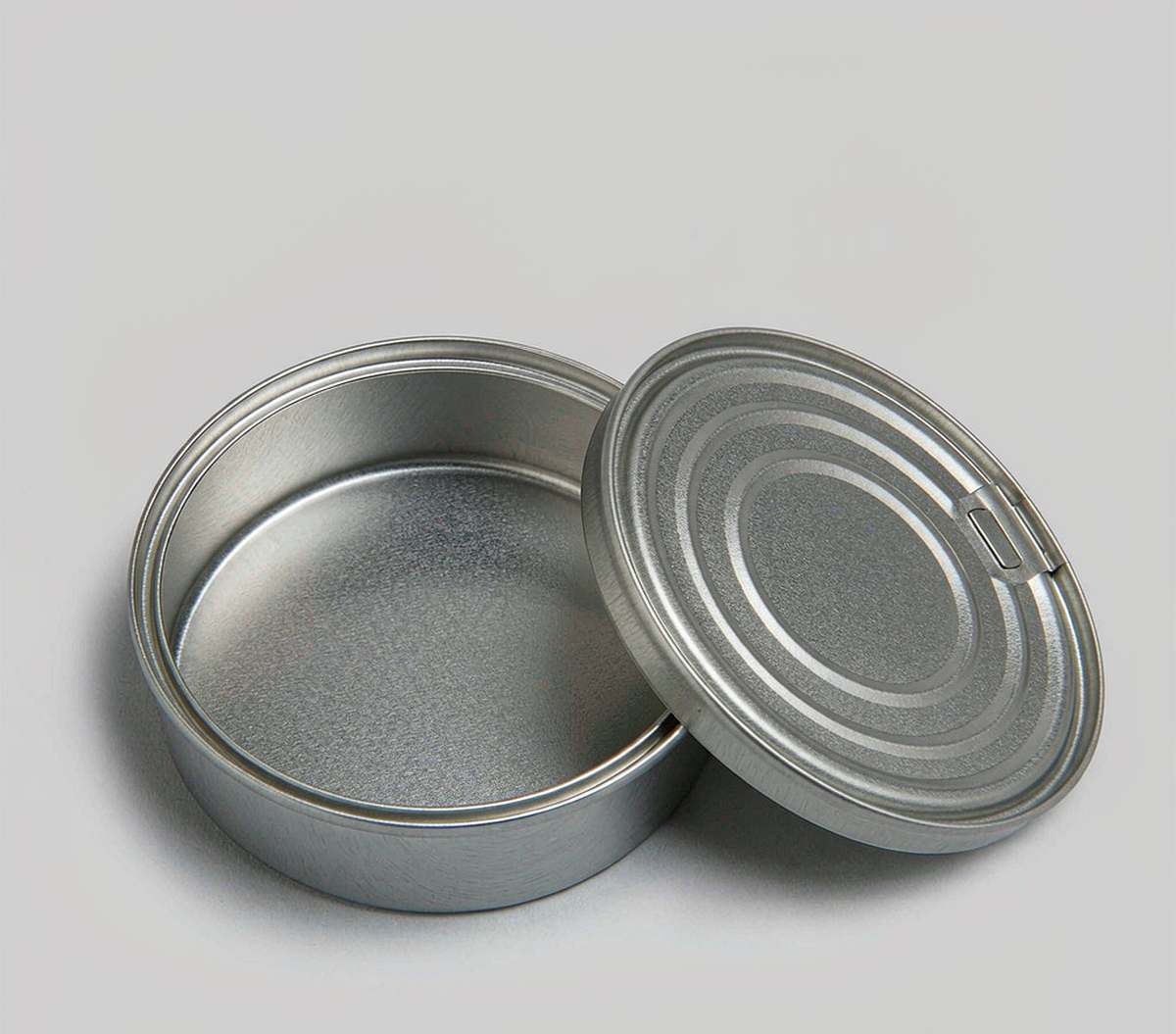
Consider a realistic scenario. A UK private-label food brand imports 200,000 units per year of 0.20 mm tinplate food cans — the kind we manufacture for the classic red-and-gold food tin line. A single 90 g can contains about 0.09 kg of steel. Across the year that is roughly 18 tonnes of steel substrate.
The taxable base is the steel's embedded direct emissions: an electric-arc-furnace route runs about 0.4–0.8 tCO₂ per tonne of steel, while a blast-furnace/BOF route lands near 1.8–2.3 tCO₂ per tonne. The tin coating and the printed decoration carry no iron-and-steel emissions, so your declaration concentrates on two facts — the steel mill's production route and the coil's country of origin. Everything else on the can is decoration.
This is where material engineering quietly lowers your bill. Downgauging the wall from 0.20 mm to 0.15 mm cuts the steel mass by about 25%, and chrome-free passivation (ECCS) removes a carbon-heavy process step. Less steel per can means less embedded carbon per can means a smaller UK CBAM line item. We covered the mechanics of specifying compliant tin-can materials and inks separately, but the carbon angle is the same: lighter, cleaner steel is cheaper to clear at the border.
The Numbers Importers Should Model Now
The UK ETS carbon price sat in the £35–45 per tonne CO₂ range through 2026. UK CBAM liability per batch equals the embedded steel emissions multiplied by the relevant UK price, minus any Carbon Price Relief for carbon already priced in the country of origin. On a practical order the charge is modest but must be declared and documented.
| Procurement parameter | Typical custom tinplate food can |
|---|---|
| Minimum order quantity (MOQ) | 5,000 units |
| Unit price — 5,000 pcs | $0.30 / unit |
| Unit price — 20,000 pcs | $0.26 / unit |
| Unit price — 50,000 pcs | $0.22 / unit |
| Tooling (new mould) | $180–350 one-time (existing moulds often free) |
| Production lead time | 25–35 days after artwork approval |
| Steel substrate per 90 g can | ~0.09 kg (0.20 mm wall) |
| Embedded carbon (EAF route) | ~0.05–0.07 kg CO₂ per can |
Run the maths on a 50,000-unit order: about 4.5 tonnes of steel, roughly 2–3 tonnes CO₂ embedded at an EAF route, charged at, say, £40 — a £80–120 declaration per batch. Small in absolute terms, but HMRC expects the data behind it, and the file has to be kept for years. Scale that to the 200,000-unit annual programme and the discipline of maintaining a clean carbon dataset becomes the real cost control, not the levy itself.
Build the Carbon Data Chain Before Q4 2026
HMRC is expected to publish an indicative or "pilot" rate during Q4 2026. Waiting for that number is the wrong move. The work that actually protects you is documentary and starts at the steel mill:
- Request a mill certificate of embedded emissions that states the production route (EAF vs BOF) and the country of origin for each coil batch.
- Map every can SKU to its steel coil batch so a customs query can be answered in minutes, not weeks.
- Retain declarations for at least four years, mirroring the EU's documentation expectations that took effect in 2026.
- Align the UK file with your EU CBAM dataset so one verified data chain serves both borders.
Dongguan Leadpack Packaging Co., Ltd supplies mill-level emission-route data with every steel specification and offers downgauged, low-carbon ECCS options on request. Treat the carbon file as part of the customization brief, not an afterthought at shipping.
Two Borders, Two Carbon Taxes — One Tin Can
Tinplate cans sit inside both the EU and UK schemes because steel is steel, regardless of which side of the Channel the can lands. The UK's direct-levy model, £50,000 threshold, and 2028 first return give importers a slightly different calendar than Brussels, but the underlying obligation is the same: prove the carbon in your steel, or pay for the gap.
For food and gift brands sourcing through the food packaging category, the path is straightforward. Specify the steel route, keep the documentation tight, and the 2027 charge becomes a predictable line item rather than a customs shock. Get the data chain in place during 2026 and the second carbon border tax is a solved problem before it ever arrives.
Need Help Choosing the Right Tin?
Tell us what you plan to pack and share an article or model you found useful. We can help confirm size, closure and sample options.